

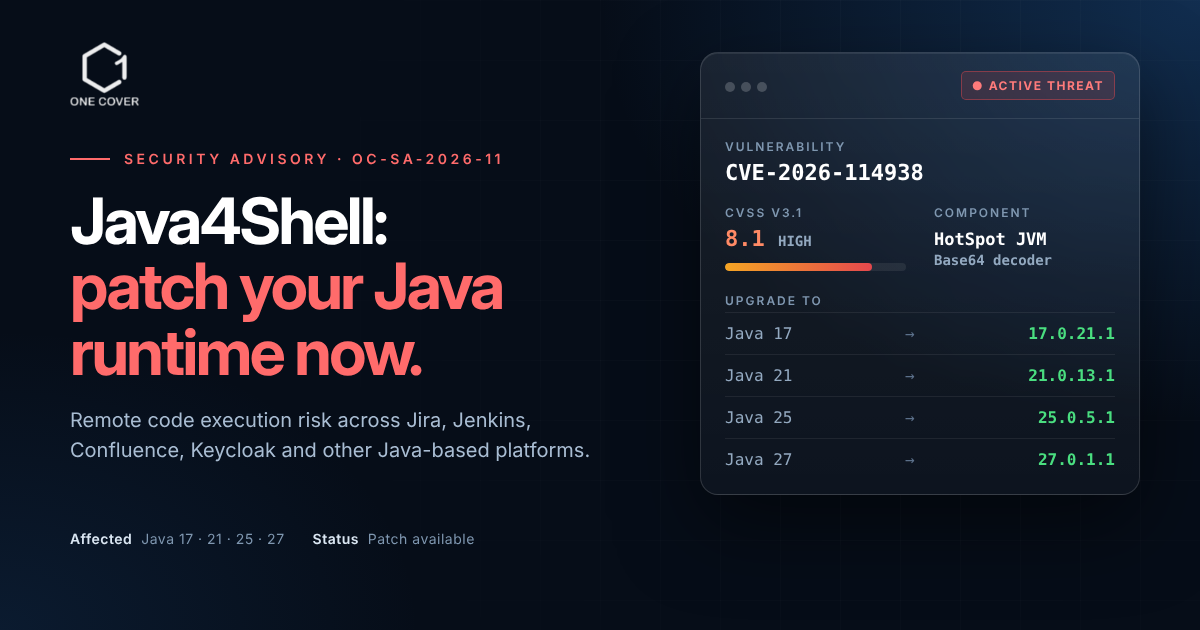
On 17 November 2026, Oracle and the OpenJDK project released security fixes for CVE-2026-114938, a memory-corruption vulnerability in the Java Virtual Machine (JVM) that the security community has named "Java4Shell". The flaw lies in a performance-optimised routine the JVM uses to decode Base64 data on modern Intel and AMD server processors. By sending specially malformed Base64 input, an attacker can cause the JVM to write data outside its intended memory boundary. Under the right conditions, this can be turned into full remote code execution on the server.
Most vulnerabilities affect a single product. This one sits in the Java runtime that thousands of products are built on. Researchers have demonstrated unauthenticated remote code execution against default installations of Jira, Confluence, Jenkins, Keycloak, JFrog Artifactory and PingFederate. Custom Java applications, including core banking components, payment gateways, government portals and internal APIs, may be equally exposed.
Treat this vulnerability as an urgent priority. Identify every Java runtime in your environment, apply vendor fixes, and use the interim mitigation in Section 9 wherever patching cannot be completed immediately. Internet-facing systems should be remediated within 72 hours.
Java is one of the most widely deployed technologies in enterprise IT. In Nepal, it underpins a significant share of banking and financial software, payment switches, telecom billing systems, ERP platforms, identity and single sign-on (SSO) services, and software development pipelines.
Three characteristics make Java4Shell particularly serious:
The vulnerability was discovered by Quang Luong, a researcher at the security firm Calif, during a security audit of OpenJDK's internal components. According to the researchers, the audit was carried out with the assistance of an AI coding agent. The flaw was identified in roughly one hour, and a first working exploit was built in about two further hours, at a total AI usage cost of under USD 200. AI agents were then used to help develop exploitation chains for specific enterprise applications.
The vulnerability was reported to Oracle and the OpenJDK Vulnerability Group under coordinated disclosure. The disclosure timeline was not entirely clean:
| Date | Event |
|---|---|
| 9 September 2026 | A proposed OpenJDK code change containing an input capable of triggering the bug was posted publicly. It later went inactive and was closed without being merged. |
| 17 November 2026 | Calif stated publicly that details of the vulnerability had leaked ahead of the scheduled fix. |
| 17 November 2026 | Oracle released its November Critical Security Patch Update and OpenJDK published fixed releases. Calif released its technical analysis and a safe proof-of-concept, but withheld application-specific exploits. CISA issued an alert urging immediate patching. |
| 18–19 November 2026 | Security firms reported internet-wide scanning and early exploitation attempts against Java services. |
The speed of discovery and exploit development is itself a warning. AI-assisted vulnerability research is shortening the time between a bug's discovery and a working exploit, which reduces the window organisations have to patch.
Base64 is an encoding scheme that represents binary data as text. Java applications decode it through the standard java.util.Base64 API. To speed up frequently used operations, the HotSpot JVM's optimising compiler (C2) can replace certain Java methods at runtime with hand-written, hardware-specific machine code known as intrinsics. On x86-64 processors that support the AVX-512 VBMI instruction set, the JVM substitutes a highly optimised assembly routine for Base64 decoding that processes 64 bytes at a time.
The defect is in how this AVX-512 routine handles the padding characters (=) at the end of a Base64 string:
=, the routine calculates an output length of zero and then subtracts one for each padding character. The length becomes negative.IllegalArgumentException. The memory is already corrupted.An uncontrolled memory overwrite usually just crashes a program. A skilled attacker, however, can use heap grooming: sending carefully sequenced requests that shape the memory layout so that the overwrite lands on an object the attacker chooses. The researchers used this technique to obtain both a controlled memory write and a memory read primitive, and chained them into arbitrary code execution inside the JVM process.
A system is vulnerable only when all of the following are true:
| Condition | Requirement |
|---|---|
| Java version | Unpatched Java 17 (17.0.6 or later), 21, 25 or 27 |
| Processor | x86-64 CPU exposing avx512f, avx512bw, avx512vbmi and bmi2, which is common on current Intel Xeon and AMD EPYC servers and many cloud instances |
| Code path | The application decodes attacker-influenced data using Base64.getDecoder() or Base64.getUrlDecoder(). The MIME decoder is not affected. |
There is no single universal exploit. An attacker must find a route by which their malicious Base64 data reaches the vulnerable decoder in a specific application. Practical routes identified so far include:
| Outcome | Difficulty | Consequence |
|---|---|---|
| Denial of service | LOW | The JVM crashes and the service goes offline. In one test, a vulnerable application crashed within about 20 seconds of repeated malformed requests, without authentication. |
| Silent data corruption | MODERATE | Application data in memory is altered without a crash, which can lead to incorrect transactions or records that are hard to detect. |
| Remote code execution | HIGH | The attacker runs arbitrary commands with the privileges of the Java service, leading to full server compromise. |
If successfully exploited, Java4Shell can give an attacker a foothold equivalent to an administrator on the affected server. Depending on the system compromised, consequences may include:
| Affected System | Potential Consequence |
|---|---|
| Identity & SSO Keycloak, PingFederate | Theft of signing keys or session tokens, allowing attackers to impersonate any user across all connected applications |
| CI/CD & artefacts Jenkins, JFrog Artifactory | Injection of malicious code into software builds that are then deployed across the organisation or to customers |
| Collaboration Jira, Confluence | Exposure of internal documentation, credentials stored in tickets or pages, network diagrams and customer information |
| Banking & payments Custom Java services | Outages of payment, banking or transaction-processing services that affect customers directly |
| Any compromised server | Lateral movement deeper into the network, ransomware deployment, regulatory breach obligations and reputational damage |
| Java Release Line | Affected Versions | Fixed Version (Oracle) |
|---|---|---|
| Java 17 (LTS) | 17.0.6 up to 17.0.21.0.3 | 17.0.21.1 |
| Java 21 (LTS) | 21.0.13.0.3 and earlier | 21.0.13.1 |
| Java 25 (LTS) | 25.0.5.0.3 and earlier | 25.0.5.1 |
| Java 27 | 27.0.1.0.3 and earlier | 27.0.1.1 |
| Java 8 – Enterprise Performance Pack | 8u511b33-perf | 8u513-perf |
| Oracle GraalVM for JDK | 17.0.21.0.3, 21.0.13.0.3 | 17.0.21.1 / 21.0.13.1 |
Affected distributions: any Java build derived from the affected OpenJDK code, including Oracle Java SE, Oracle GraalVM, Amazon Corretto, Eclipse Temurin, Microsoft Build of OpenJDK, Azul Zulu, BellSoft Liberica, SAP SapMachine and Red Hat build of OpenJDK. Each vendor publishes its own fixed build numbers, and some vendors released fixes later than Oracle.
Standard Java 8 and Java 11 releases, systems on ARM64 processors (including AWS Graviton and Apple Silicon), and x86-64 processors without AVX-512 VBMI support. Note that Oracle's November 2026 update also fixes ten other Java SE vulnerabilities, so Java 8 and 11 users should still apply it.
| Exploitation Type | Products |
|---|---|
| UNAUTHENTICATED RCE | Atlassian Jira, Atlassian Confluence, Jenkins, Keycloak, JFrog Artifactory, PingFederate |
| AUTHENTICATED RCE | Apache Kafka Broker, Apache Solr, Elasticsearch, Gerrit, Spinnaker |
| SAMPLE APPLICATIONS | Spring Boot, Apache Struts |
Step 1: Apply the security update. Upgrade every affected Java runtime to the November 2026 fixed release from your Java vendor (see Section 7). After upgrading, restart every Java service: a running JVM keeps using the old, vulnerable code until it is restarted.
Step 2: Apply the interim mitigation where patching is delayed. If a fixed runtime cannot be deployed immediately, for example because a vendor has not yet released an update for a bundled product, disable the vulnerable code path by adding the following JVM option and restarting the service:
-XX:-UseBASE64IntrinsicsThis makes the JVM use the standard Java Base64 implementation instead of the vulnerable AVX-512 routine. The performance impact is negligible for typical workloads such as login endpoints and API requests. Only applications that decode very large volumes of Base64 data are likely to notice a difference.
Common ways to apply the option:
# Environment variable (picked up by most JVMs at start-up)
export JAVA_TOOL_OPTIONS="-XX:-UseBASE64Intrinsics"

# Apache Tomcat / Jira / Confluence – add to bin/setenv.sh
CATALINA_OPTS="$CATALINA_OPTS -XX:-UseBASE64Intrinsics"

# Docker / Kubernetes – set as a container environment variable
JAVA_TOOL_OPTIONS=-XX:-UseBASE64Intrinsics

# systemd-managed service – add to the service unit
Environment="JAVA_TOOL_OPTIONS=-XX:-UseBASE64Intrinsics"
An alternative option, -XX:UseAVX=2, disables all AVX-512 instructions. It may reduce performance more broadly, and the JVM will not start with it on ARM systems. Prefer -XX:-UseBASE64Intrinsics where possible.
These options are temporary mitigations and do not replace patching. Test them in a non-production environment first, and remove them once a fixed runtime is installed.
Step 3: Prioritise by exposure. Remediate in this order:
eclipse-temurin or openjdk, remain vulnerable until they are rebuilt on a fixed base image and redeployed.= characters in unexpected positions. Treat this as an additional layer only, because it can produce false positives and is not a substitute for patching.# 1. Check the installed Java version
java -version
# 2. Check the version of a running Java process
jcmd <PID> VM.version
# 3. Check CPU support for the vulnerable instruction sets (Linux)
grep -m1 '^flags' /proc/cpuinfo | tr ' ' '\n' | grep -E '^(avx512f|avx512bw|avx512vbmi|bmi2)$'
# All four must be listed for the vulnerable code path to be used.
# 4. Confirm whether the interim mitigation is active
jcmd <PID> VM.flags -all | grep -E 'UseBASE64Intrinsics|UseAVX'
# 5. Find all running Java processes on a Linux host
ps -eo pid,user,args | grep -i '[j]ava'Hypervisors may hide CPU features from virtual machines, so run the CPU check inside each VM or container, not on the physical host. Confirming the vendor's fixed build number is the most reliable way to verify remediation. Safe proof-of-concept tests can give misleading results on some Java versions and should not be the only verification method.
| Indicator | What to Look For |
|---|---|
| JVM crashes | New hs_err_pid*.log crash files on application servers |
| Decoder errors | Spikes in Base64-related IllegalArgumentException errors in application logs |
| Malformed headers | Authentication values with stray or unusual = padding, especially in high volumes from one source |
| Suspicious processes | Java services spawning sh, bash, cmd.exe, powershell, curl or wget |
| Network anomalies | Unusual outbound connections from Java application servers |
| Data anomalies | Unexplained changes in application records, which may indicate silent memory corruption |
If any of these indicators appear on an unpatched system, treat it as a potential compromise: isolate the system, preserve logs and memory where possible, and begin incident response.
| # | Action | Priority |
|---|---|---|
| 1 | Inventory all Java runtimes, including bundled and containerised ones | IMMEDIATE |
| 2 | Confirm CPU support for AVX-512 VBMI on each host | IMMEDIATE |
| 3 | Upgrade to the November 2026 fixed Java release and restart services | IMMEDIATE |
| 4 | Apply -XX:-UseBASE64Intrinsics where patching is delayed | IMMEDIATE |
| 5 | Patch internet-facing, identity and CI/CD systems first | IMMEDIATE |
| 6 | Rebuild and redeploy container images | SHORT-TERM |
| 7 | Apply vendor updates for products that bundle Java | SHORT-TERM |
| 8 | Deploy WAF rules, rate limiting and exposure reduction | ONGOING |
| 9 | Monitor for crashes, malformed Base64 and suspicious processes | ONGOING |
| 10 | Remove temporary JVM flags once patched and verified | AFTER PATCH |
One Cover Pvt. Ltd. helps organisations across Nepal respond quickly and effectively to critical vulnerabilities such as Java4Shell.
To request assistance, contact info@onecovernepal.com
Disclaimer: This advisory is based on information available at the time of publication and is provided for awareness and guidance purposes. Organisations should validate changes in a test environment and consult their software vendors' official security advisories before modifying production systems. One Cover will update this advisory if significant new information becomes available.
— One Cover Team