

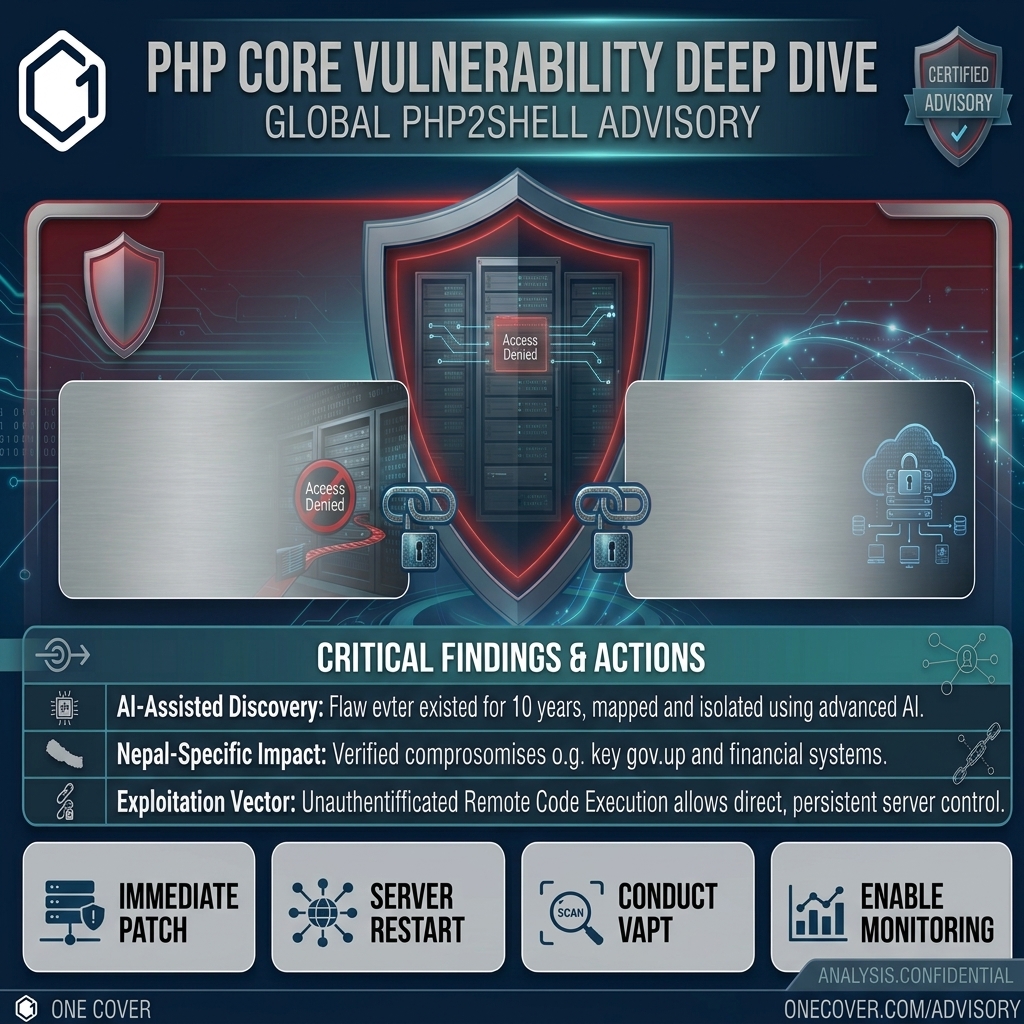
Recent reports by prominent news portals like OnlineKhabar have brought to light a stark reality regarding national cyber resilience: the discovery of the PHP2Shell vulnerability (tracked under CVE-2026-109618 and CVE-2026-109619). With a critical CVSS score of 9.2, this flaw bypasses traditional application logins entirely, granting unauthorized entities direct remote execution privileges at the server core level.
Unlike routine application bugs found inside specific website codes (such as a vulnerable plugin), PHP2Shell compromises the underlying foundation—the PHP processing layer itself. When emergency updates were released globally, web infrastructure in Nepal faced an immediate litmus test. Critical portals, executive offices, and ministerial directories experienced extensive preventative downtime.
A fascinating and alarming dimension highlighted in the security analysis is the role of Artificial Intelligence (AI). Cybersecurity firm Wiz revealed that these structural flaws had remained hidden in core PHP code for over a decade.
While advanced AI tools enabled defensive researchers to map and isolate the vulnerabilities quickly, the same technical capability means malicious actors can synthesize functional exploits within hours rather than months. Global authorities—including the US National Security Agency (NSA), European cybersecurity units, and national response cells—urged immediate system isolation where patching was not instantly feasible.
While government bodies successfully initiated phased restorations after rigorous server validation, the threat extends deeply into the private sector:
| Vulnerability Aspect | Technical Detail | Impact Level |
|---|---|---|
| Identifiers | CVE-2026-109618 & CVE-2026-109619 | Critical (9.2 CVSS) |
| Authentication | None Required (Pre-authentication exploit) | High Risk |
| Remediation | Update to patched PHP runtimes (8.2.35+ / 8.3 / 8.4) and restart PHP-FPM/Apache services | Mandatory |
If your enterprise operates an e-commerce platform, corporate website, or client portal built on PHP, complacency is no longer an option. Take immediate stock of your security posture:
The PHP2Shell incident serves as a powerful reminder that digital infrastructure requires constant vigilance. Software updates are never mere administrative checkboxes—they are the foundational pillars protecting public trust, corporate data, and national digital sovereignty.
One Cover Pvt. Ltd. specializes in advanced cybersecurity audits, VAPT testing, and infrastructurehardening in Nepal[cite: 4]. If your organization needs a professional review of its web security posture and PHP patch compliance, contact our expert engineering team today[cite: 4].